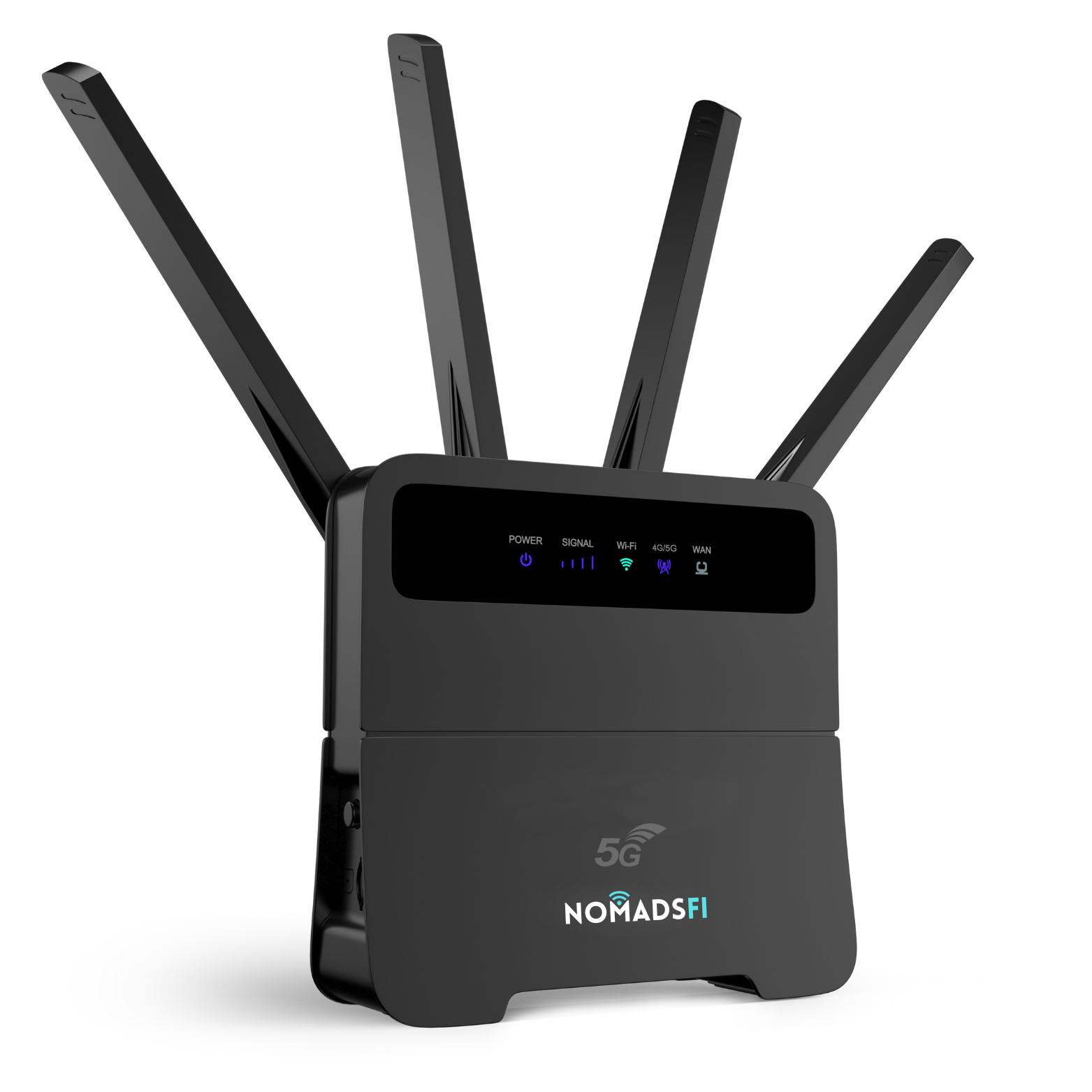
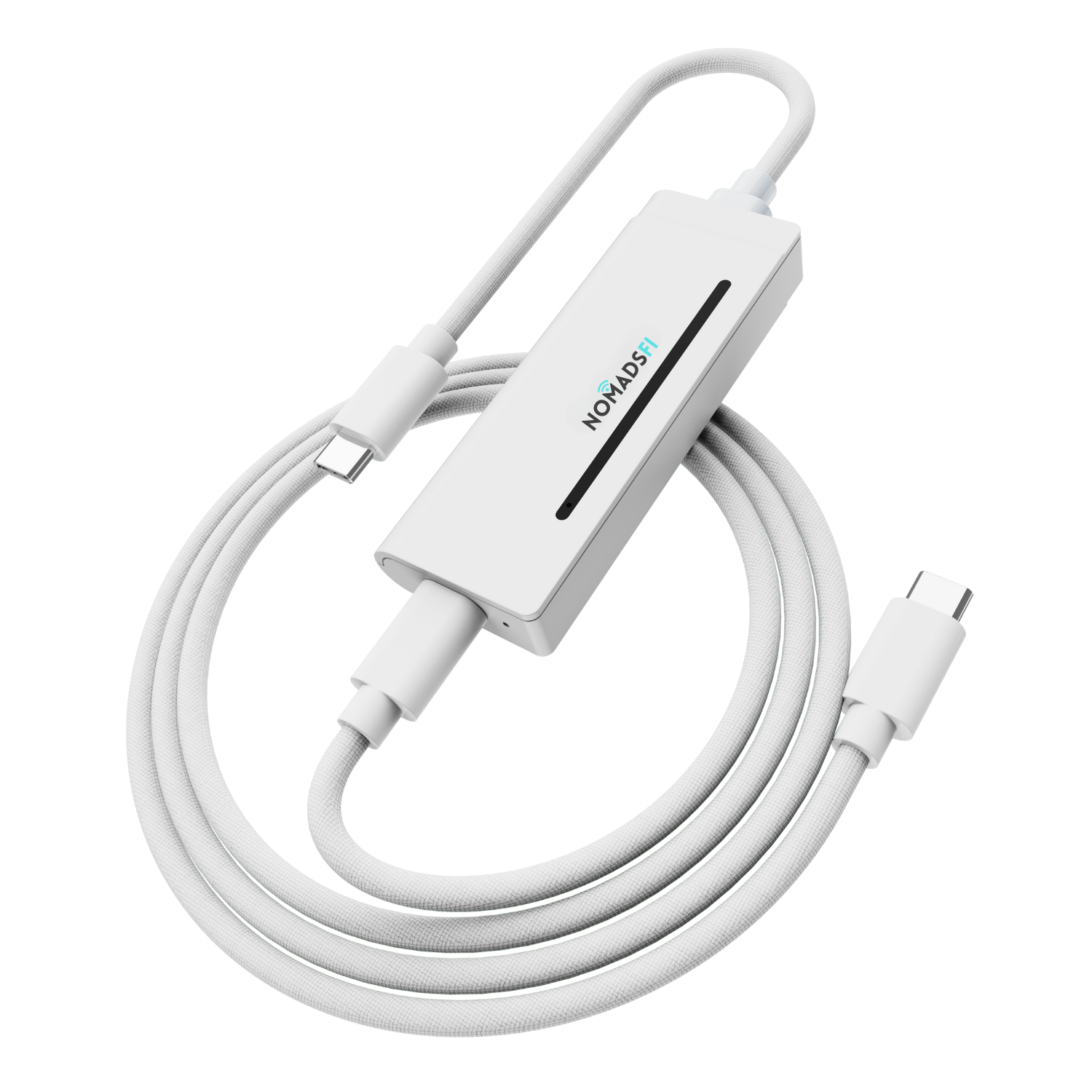
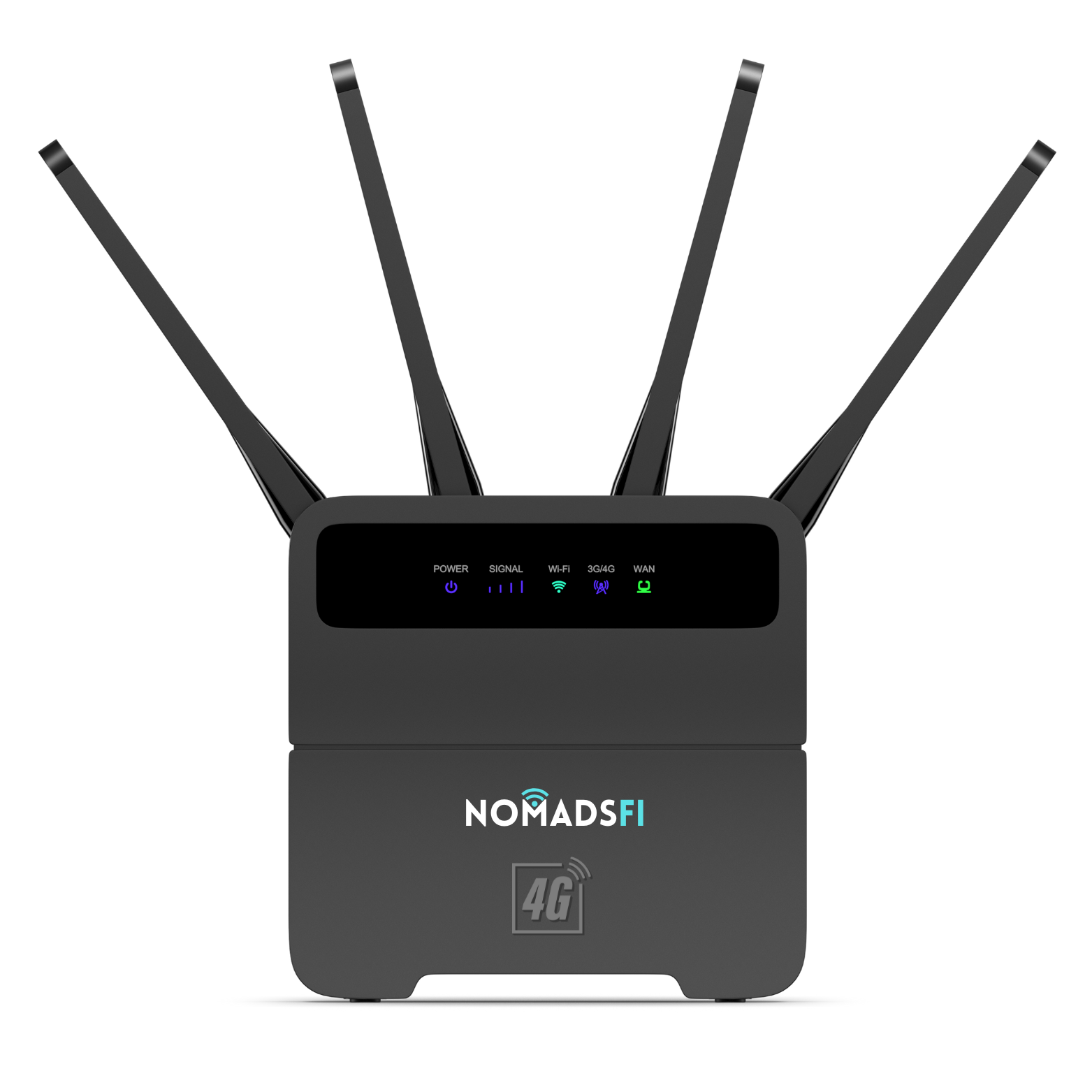
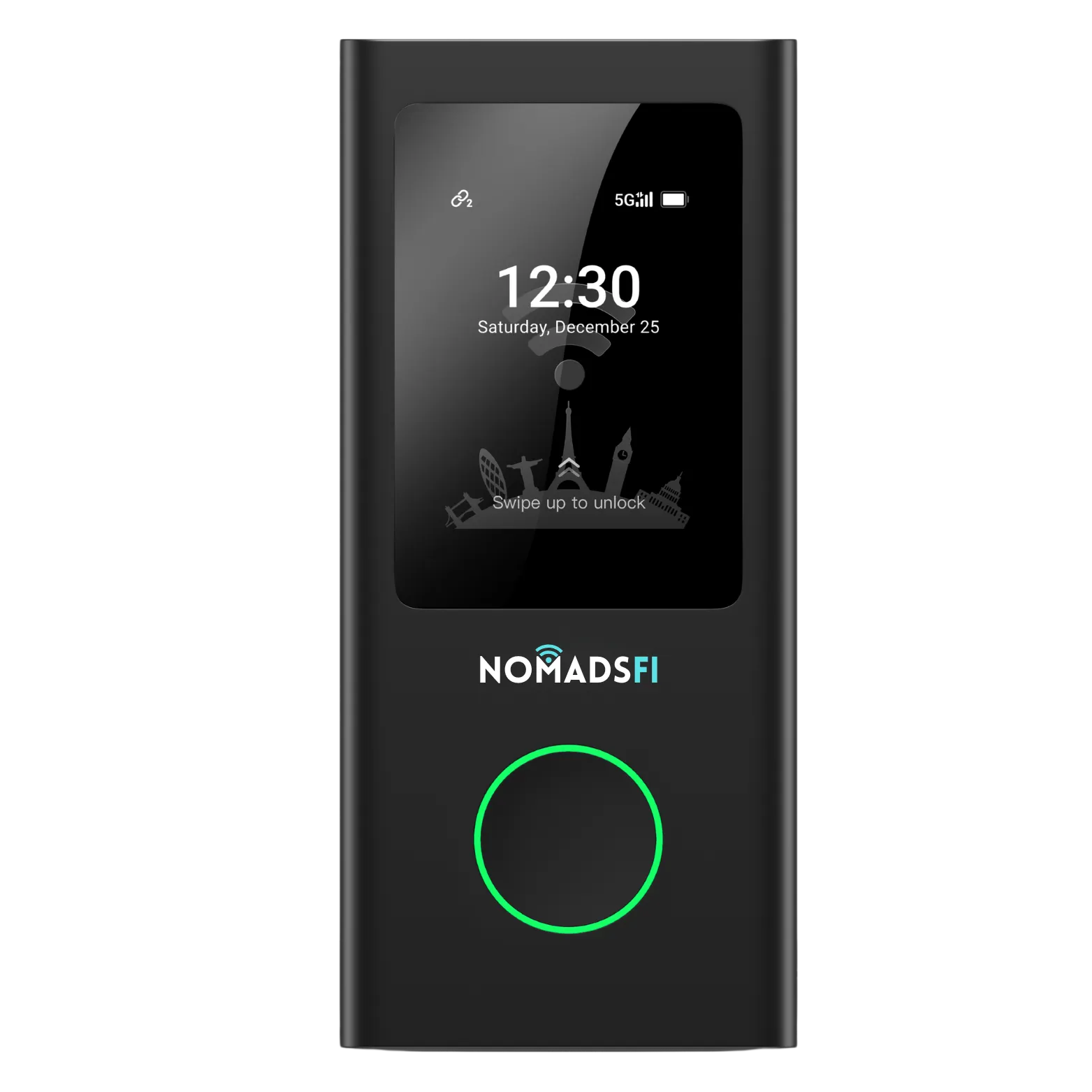

Cover: AI-generated small-business scene using a NomadsFi router reference; not a photograph of an actual customer deployment.
A customer wants broadband today. Your fiber build reaches the neighborhood in a few months. Across town, an existing business customer has a different problem: the primary line is down, and staff need the payment terminal and order system working again.
For U.S. and Canadian broadband providers, a cellular service can cover the wait for installation and provide a second path when the fixed line fails. A NomadsFi 5G router shares that connection with devices at the property. The ISP can start with an interim service, then retain the equipment as business internet backup through a compatible network design.
This is part of the NomadsFi ISP partner proposition: reach customers in areas awaiting wired service and offer wireless backup to business locations. The two application cases below explain how to turn that proposition into an installation and support process.
These are deployment scenarios for ISP evaluation, not measured results from a named NomadsFi operator customer. Automatic failover requires a validated hardware and network configuration.
How can an ISP use NomadsFi hotspots and routers?
Use temporary broadband to serve a customer while a fixed line is being built. Use ISP internet backup to restore selected business applications during an outage. The first plan carries everyday traffic; the second needs enough capacity for the agreed recovery workload.
| Application | Customer need | NomadsFi role | ISP success measure |
|---|---|---|---|
| New customer acquisition | Internet before the wired service is ready | A router or hotspot with eligible cellular service | Working activations and subsequent broadband conversions |
| Business backup | Access to essential applications when the main line fails | A cellular path connected through a tested backup arrangement | Application recovery, support demand and customer retention |
A cellular router is customer premises equipment, or CPE. It reaches a mobile network and shares the connection locally. The availability of fixed wireless access depends on usable cellular coverage at the property, even where a fiber cable has not arrived.
Application case 1: ISP customer acquisition before fiber arrives
Consider a neighborhood scheduled for a fiber rollout in three to four months. A household needs internet for work and school now; a local shop needs to open before its fixed-line appointment. For ISP customer acquisition, a working interim connection gives the sales team something useful to offer while construction continues.
With a NomadsFi cellular service, the ISP can offer internet before fiber installation. After checking the property, the team supplies an activated router, demonstrates the connection and keeps the customer informed about the wired build. The customer starts using a service while the ISP develops the longer-term relationship.
U.S. teams can use the FCC's National Broadband Map guide to compare provider-reported service availability at an address, including fiber and fixed wireless. Use that information to shortlist properties, then check the proposed cellular service inside the building.
This interim use has an established commercial parallel: AT&T Internet Air for Business describes temporary connectivity for new or remote locations. The ISP's own program still needs a package suited to the customer's months of everyday use.
This approach to broadband customer acquisition works best when the interim offer has a clear place in the order. Explain the monthly allowance, expected use, equipment ownership or return terms and how the future fiber appointment will be arranged. A three- to four-month bridge is a planning example, not a guaranteed construction schedule.
A practical path from first order to fiber
- Qualify the property. Confirm cellular eligibility, test indoor reception and agree which household or business applications the interim plan must support.
- Activate the temporary service. Give the customer a configured unit and demonstrate their actual devices. Record the unit and package against the customer order.
- Keep the installation order moving. Update the customer when the wired service becomes ready and book the fixed-line visit.
- Complete and verify the migration. Check applications over the new line, then recover the cellular unit or agree to retain it as a paid backup service.
Keep the migration in the original order: book the fixed-line installation, verify the new service and explain the billing change. The customer should know whether the router will be collected or retained as a backup.
Choosing a 5G router or WiFi hotspot for the interim service
For an occupied home or small office, a powered router is a useful starting point. The NomadsFi device overview lists up to 32 connected WiFi devices for the 5G router and up to 16 for PocketFi 5G. The users share the available bandwidth and data allowance.
A WiFi hotspot for business suits a smaller group, a temporary desk or a technician helping a customer reconnect a few essential devices. A site that must keep its existing wired terminals or access points online needs an agreed gateway connection, rather than simply another WiFi name.
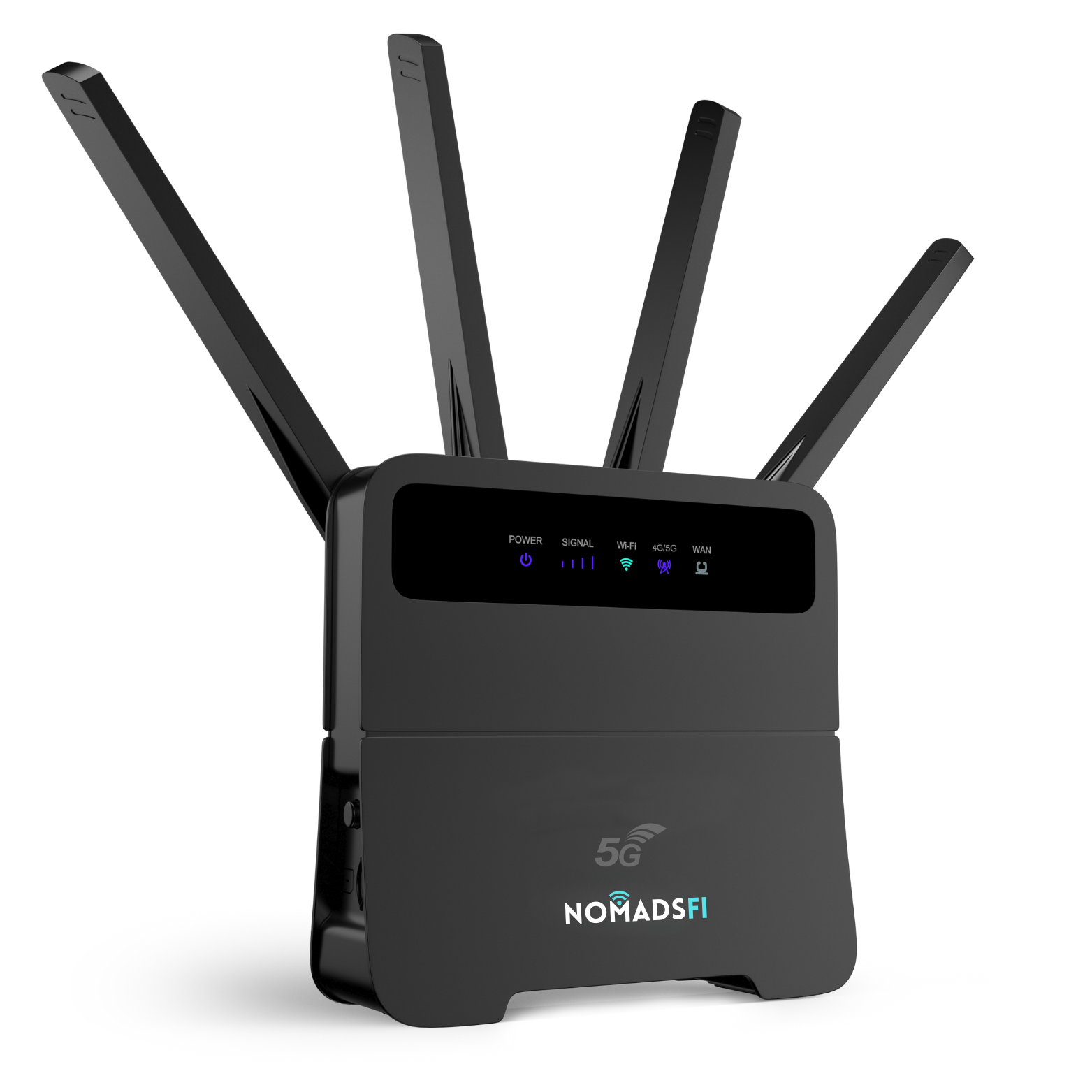
When evaluating a 5G router for ISPs, test the customer applications at the property and confirm how the device will connect to the existing network. Include VPN or public-IP requirements in that discussion; a service intended for everyday browsing may need additional design for those applications.
Our portable hotspot guide covers the portable-device format. For several sites, the enterprise connectivity guide explains the management problem that comes with distributing hardware.
Application case 2: ISP internet backup for a business outage
A shop can lose fixed broadband while the lights, local network and payment equipment remain powered. Staff may have a phone with data, yet the store's equipment still has no usable path to the internet. Installing backup before the incident gives the support team a prepared response.
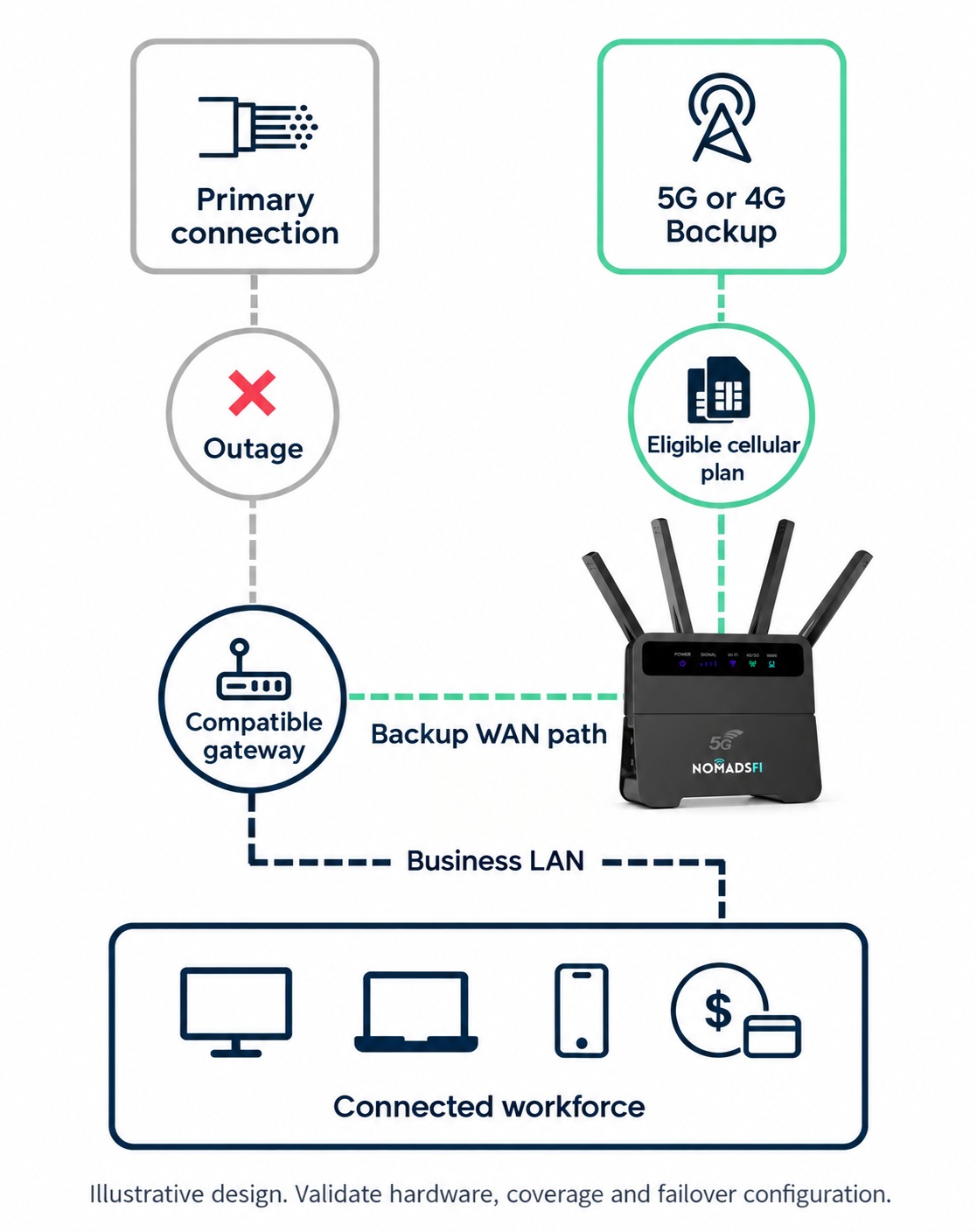
In an ISP internet backup program, NomadsFi supplies an eligible cellular connection. The ISP or network integrator connects it through compatible equipment, tests the essential applications and documents what should happen when the primary service becomes unavailable.
Start with the work that cannot wait, such as payment authorization on a compatible terminal or access to the cloud order system. The Canadian Centre for Cyber Security's IT recovery guidance recommends identifying critical applications and recovery priorities. For a cellular backup service, use that shortlist to decide what must be tested and what traffic can wait.
Test those applications with the customer and their software providers. Limit large downloads or guest streaming where necessary to preserve the shared allowance for essential work.
Primary path: Fixed broadband → compatible gateway → business LAN
Backup path: Eligible cellular network → NomadsFi equipment → compatible gateway → business LAN
If the site only needs a few compatible WiFi devices, staff can instead connect them manually to a PocketFi 5G hotspot. That can be a practical recovery option, provided the service is sold and supported as a manual process.
What automatic WAN failover needs to work
Automatic WAN failover requires equipment that checks whether the primary internet path works and changes the route when it fails. The presence of a cellular router by itself does not establish this behavior.
Ubiquiti's gateway documentation, for example, describes WAN health monitoring, standby links and a return to the primary path after recovery. The ISP should validate those functions on the actual gateway and firmware it will install.
For a NomadsFi design, agree whether the backup reaches the gateway through supported Ethernet, WiFi WAN or another approved interface. Confirm which unit performs failure detection. Test an upstream outage as well as a disconnected cable; a physical link can remain active while the service beyond it fails.
Cellular failover can change the public IP address and interrupt existing sessions. Cox's backup-service FAQ, for example, says its LTE backup uses a dynamic address in place of the fixed service's static IP. Test whether a payment transaction, VPN or voice call recovers or must reconnect, then set the recovery target from those results.
Include failback in the test: the primary line returns, the gateway confirms it is stable, and traffic moves back under the agreed policy. Check power for the cellular unit, gateway, switch and customer equipment. Verizon's published backup-service conditions also identify backup power as a requirement during a power outage. Regional power or backhaul failures can affect both internet paths.
Where a multi-carrier router adds flexibility
An ISP may serve a mix of street-front shops, offices and homes. The strongest supported cellular network can differ from one address to the next, or with router placement inside the same building.
A multi-carrier router gives the deployment team supported network options under the selected service. Ask which carriers the device and package allow at each site, then test the connection where the unit will be installed. In a U.S. proposal, confirm the applicable AT&T, T-Mobile or Verizon options rather than treating a national coverage statement as a site survey.
At each site, the ISP has two decisions to make: which supported mobile network gives the cellular link a usable signal, and how the gateway routes traffic onto it when fixed broadband fails. Carrier selection addresses the first. WAN failover handles the second. Neither establishes simultaneous network bonding or uninterrupted sessions.
The coverage list helps qualify destinations, and the partner page describes a 200+ country service footprint. Each deployment still needs eligible local service and commercial terms. For an operational example of shared router connectivity, see our inventory-counting router case study; it illustrates a different application, not a broadband-failover test.
Adapting the service for U.S. and Canadian ISPs
United States: qualify each service address
For temporary internet in the U.S., compare provider-reported availability using the FCC's map guidance, then test the proposed cellular connection at the property. Confirm the eligible U.S. plan and supported carriers. A plan advertised for one operating area should not be assumed to include service across the border.
Canada: use Canadian coverage and package terms
When evaluating 5G internet for Canadian ISPs, use ISED's National Broadband Data to shortlist service areas. NomadsFi lists Canada in its coverage area; confirm a package and hardware combination approved for the intended Canadian site and duration. Check supported local carriers with NomadsFi when designing the program.
Business internet backup in Canada is also an established service category. Bell's business Internet page describes Wireless Backup for a disrupted Bell wireline connection. It is a local comparison point, not a claim that Bell supplies the proposed NomadsFi service.
Keep one workflow, with a country-specific service record
Use the same activation, support and recovery checklist in both markets. Record the country, eligible service, gateway configuration, billing currency and customer terms for each site. Customers waiting for fiber need a suitable primary-use allowance; customers buying standby backup need a tested recovery scope. Agree these separately for the U.S. and Canada.
How established wireless and backup offers compare
Published ISP offers show that temporary access and wireless backup are established service categories. AT&T Internet Air for Business describes temporary connectivity for new or remote locations. Verizon's backup offer describes automatic switchover with compatible equipment. They provide useful reference points for defining a NomadsFi-based service.
| Approach | Where it fits | What to check |
|---|---|---|
| NomadsFi router or hotspot program | Interim internet and a cellular path for an ISP's validated backup design, with supported carrier options | Site reception, data allowance, gateway compatibility, management scope and commercial agreement |
| AT&T Internet Air for Business | Fixed wireless access, including temporary service at new or remote locations | Address eligibility, router requirements and the intended primary or backup configuration |
| Verizon Backup and Flexible Use Internet | Wireless standby service and low-data applications | Compatible router, allowance, overage terms and backup power |
| Cox Business Net Assurance | A packaged LTE backup service associated with eligible business plans | Local availability, supported applications, backup-speed and static-IP limitations |
| Bell Canada Wireless Backup | A Canadian business backup offer for a disrupted Bell wireline connection | Address and service eligibility, equipment, support and package terms |
| A second wired circuit | A site that needs another fixed connection and can obtain a suitable installation | Build time, cost and whether the two services share physical infrastructure |
Cox's published service also shows why the backup scope matters: its documentation describes 4G LTE backup with reduced bandwidth and limits on guest WiFi and static-IP behavior. An ISP should give its customers equally clear expectations for the service it deploys.
For historical operator context, uCloudlink announced a China Unicom Shenzhen partnership in November 2020 covering mobile broadband and related services. It provides background on operator partnerships; it is not a NomadsFi deployment report.
Manage the service from activation through recovery
Once an ISP has more than a handful of devices in service, knowing which customer has which unit becomes essential. Tie the device identifier to the site, service purpose, package and support contact. Keep a different service label for an interim primary connection and a standby backup.
The NomadsFi B2B program describes centralized management. Review the required account visibility, usage reporting and activation controls with the team. Confirm any integration with the ISP's ordering or billing systems during commercial design.
Allowances should match the job. A household using cellular as its main internet for several months needs a different budget from a shop reserving a connection for occasional payment processing. Compare the current data packages with estimated busy-day use and agree what happens if an outage extends beyond the initial allowance.
Give support staff a short recovery guide showing the primary service, cellular status and an application test. Include customer steps for a manual-hotspot service. Schedule broadband disaster recovery tests to catch an expired plan, changed gateway setting or unpowered unit before an incident. The Canadian recovery-planning guide also calls for testing the plan; the exercise should cover the people and applications that depend on the connection.
What to measure in an ISP pilot
The acquisition case aims to win an order sooner and carry it through to a working fixed-line installation. The backup case aims to reduce the disruption customers experience. Both can support satisfaction and retention when the customer understands the service and it performs as agreed.
Fewer outage-related refund requests or service-credit claims would be useful outcomes to measure. Their financial effect depends on the ISP's contract and incident history; a backup connection does not automatically remove an SLA obligation or contractual penalty.
| Program | Measure | Record alongside it |
|---|---|---|
| New acquisition | Working interim activations, returns and later fixed-line conversions | Eligible addresses, build delays, installation outcomes and cancellations |
| Business backup | Essential-application recovery and outage duration experienced by the customer | Failure type, coverage, configuration, power and any manual actions |
| Customer experience | Complaints, refunds or service credits, and post-incident satisfaction | Customer cohort, contract, incident severity and comparison period |
| Commercial performance | Contribution after service and hardware costs | Data use, activation work, support time, logistics and equipment recovery |
Start with a small group of qualified sites. Confirm that new customers can complete their daily tasks and that backup customers can recover the applications in scope. Use those records to decide where a wider rollout makes commercial sense.
Frequently asked questions
Can an ISP use a 5G router before fiber is available?
Yes, where eligible cellular service is usable at the property. The ISP can offer an interim plan, qualify the site and later arrange the fixed-line installation. Cellular availability must be checked separately from the fiber build map.
Can customers move to broadband after three or four months?
That is a possible planning window when the wired build is expected then. The actual migration depends on service readiness, the customer agreement and the ISP installation process. Arrange the billing change and the return or backup use of the cellular unit.
Does a NomadsFi hotspot automatically take over from a failed broadband line?
A hotspot can supply a separate WiFi connection for manual recovery. Automatic switchover needs compatible gateway equipment, an approved connection to the cellular unit and a tested failover configuration. Confirm the exact device and firmware before selling an automatic service.
How is carrier switching different from broadband failover?
Carrier selection chooses a supported mobile network for the cellular connection. Broadband failover changes the business network from its primary internet path to a backup path. They are different functions and neither by itself promises uninterrupted sessions.
How many devices can share a NomadsFi router or hotspot?
NomadsFi lists up to 32 connected WiFi devices for its 5G router and up to 16 for PocketFi 5G. Connected devices share bandwidth and the plan allowance. Test the number and type of applications the site needs to run.
Can cellular backup keep payment terminals and business VPNs online?
It can provide a recovery path for compatible applications, but the ISP must test the actual terminal, software and VPN configuration. Address changes, connection requirements and session restarts can affect recovery.
Does internet backup work in a power outage?
The cellular unit, gateway and equipment needed by the business must remain powered. Plan and test backup power for the required devices. Regional power, mobile-network or backhaul failures can affect the cellular path as well.
Will backup reduce complaints, refunds or SLA penalties?
A working backup service can reduce the disruption a customer experiences, which may help satisfaction and retention. Measure claims and support contacts against a defined baseline. Any refund, service credit or penalty remains subject to the customer contract and incident facts.
Can the ISP manage many NomadsFi devices centrally?
NomadsFi describes centralized enterprise management in its B2B program. Agree the required device visibility, reporting, service controls and any order-system integration with the business team before rollout.
Can ISPs use this approach in both the United States and Canada?
Yes, as a deployment approach using eligible service at each site. NomadsFi lists Canada in its coverage area alongside its U.S. services. Confirm the device, local carriers, package validity, commercial terms and gateway compatibility separately for each country; a U.S. plan is not automatically a Canadian plan.
Plan an ISP acquisition or backup pilot with NomadsFi
Tell us which addresses you want to serve, when wired service is expected and which applications must keep working during an outage. Include your existing gateway models and the number of sites so the proposal can cover hardware, eligible data service and the deployment process.
Discuss an ISP partner program
Explore the NomadsFi 5G router for site connectivity or PocketFi 5G for portable shared WiFi. Check coverage and plan options, then agree the commercial and technical requirements for your ISP service.
Sources and further reading
Written by NomadsFi Team. Official product and service pages reviewed October 27, 2026. The operator announcement below is historical. Comparisons use published service descriptions, not a joint performance test. Application workflows are proposed designs and require validation at the customer site.
- NomadsFi partner program: ISP acquisition, business backup and centralized management
- NomadsFi 5G router: current product information
- NomadsFi device overview: router and PocketFi connection limits
- NomadsFi PocketFi 5G: portable hotspot and carrier selection
- NomadsFi destination coverage
- NomadsFi data packages
- AT&T Internet Air for Business: fixed wireless and temporary connectivity
- Verizon Business: Backup and Flexible Use Internet
- Cox Business: Net Assurance LTE backup and operating limits
- Ubiquiti: WAN failover, monitoring and recovery behavior
- FCC: using the National Broadband Map to compare reported service availability
- Canadian Centre for Cyber Security: critical applications and IT recovery testing
- ISED Canada: National Broadband Data and service availability mapping
- Bell Canada: business Internet and Wireless Backup service
- uCloudlink: historical China Unicom Shenzhen partnership announcement, November 2020